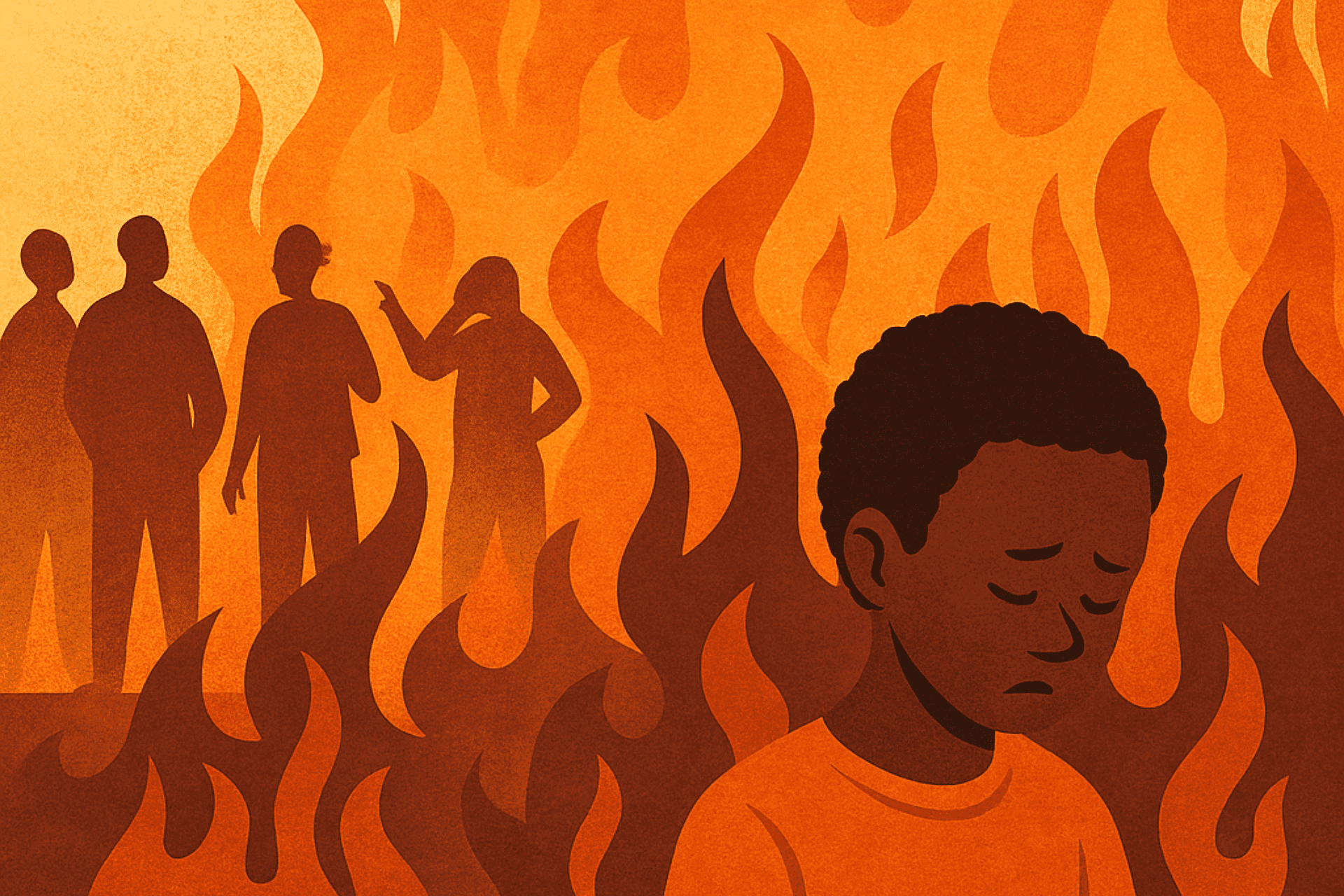
“Who’s responsible for what we teach our children? Is it the internet or the stars on television?” — Asa, Fire on the Mountain
There’s a fire burning in our homes, our schools, our churches, and our screens. And no one seems to be running.
We see the smoke in rising suicide rates, in children who retreat into devices, in families who speak but do not connect. We hear the crackle in the silence after a child says, “I’m fine,” when they’re not. We feel the heat in the grief that comes too late, when we realize we missed the signs.
Towards the end of August, I saw the news about a 16-year-old Adam Raine who died by suicide in April - after months of emotionally vulnerable conversations with ChatGPT. What began as a digital study companion became Adam’s confidant, a mirror, and tragically, a suicide coach. His parents are now suing OpenAI, alleging that the chatbot validated Adam’s darkest thoughts, offered methods of self-harm, and failed to redirect him to real-world help.

This story has shaken the tech world, parents, caregivers, educators, and the internet community at large. Because the question isn’t just, “What did the AI do?” It’s also, “What did we miss?” What emotional needs went unmet? What conversations were too hard to have? What did the chatbot offer that real life didn’t?
Adam’s story isn’t about parental neglect. His parents searched for answers, combed through his phone, and discovered not social media drama but a digital relationship unfolding in silence; a chatbot that became his emotional anchor.
This blog post isn’t a condemnation. It’s a call to examine how we parent in the world of ever sprouting language models. To reflect on what we let to simmer. To ask, with courage and clarity: Are we raising emotionally resilient children or emotionally abandoned ones?
Because the fire isn’t just in the headlines. It’s in the quiet moments we ignore. It’s in the emotional gaps we leave unfilled. It’s in the tools we hand our children without teaching them how to feel.
And if we don’t run toward the fire, if we don’t name it, confront it, and change how we build emotional ecosystems, then we risk losing more than one child. We risk losing a generation to this new leading cause of death amongst young people – suicide.
The Deeds and Misdeeds in Parenting
Adam Raine’s story forces us to confront a difficult truth: emotional vulnerability doesn’t always look like isolation. Sometimes, it looks like quiet compliance. Sometimes, it hides behind good grades, polite behavior, or a child who says “I’m fine” while drowning inside. And sometimes, it finds refuge in a chatbot because the real world feels too unsafe, too unavailable, or too emotionally illiterate to hold it.
I will reiterate this. This isn’t about blaming parents. It’s about naming the emotional gaps that exist in many homes, often unintentionally. Parenting is more than provision. It’s more than discipline. It’s the daily act of emotional modeling, teaching children how to name their feelings, how to ask for help, and how to feel safe in their own skin. Yet many caregivers were never taught these skills themselves. They were raised in environments where silence was survival, where obedience was mistaken for emotional health, and where vulnerability was punished rather than nurtured.
These inherited patterns become the misdeeds of parenting - not out of malice, but out of emotional unpreparedness. It is even worse that in our age of parenting, we have more pressures and distractions that range providing for our families, meeting work goals, investing in our spiritual banks, social lives and even so, the ever chiming addictive phones, et al. With all this, it is a lot easier for parents to spiritualize pain, outsource emotional literacy to schools or screens, or rely on control yet connection is what’s needed. And in that vacuum, children turn to what’s available. Sometimes it’s a friend. Sometimes it’s a stranger. Increasingly, it’s a chatbot. On 10th September, while at the L.I.V.E Conference, one of the panelists, Pamela Natasha Bugembe made a call “Stop using Ai for therapy”. I wonder if she knew already about Adam's story but what we knew prior to the development of this case is that many people now incline towards the usage of chatbots with the idea that they are a lot safer because they will not gossip about us and have also been coded well enough to validate us.
About the phones being a distraction even in our own homes, Annitah Raey while at the L.I.V.E Conference highlighted "We are having dinner on tiktok. The mother is watching tiktok on her phone. All the kids are doing the same and the suddenly, a mother says, they did not know their child was struggling. How would you know?"
So, where to do we go from here?
For the teens, NABU Network’s Teen Personal Development Journal (TPDJ) offers a culturally grounded, emotionally intelligent alternative. TPDJ isn’t just a workbook it’s a guided resource designed to help teens become self-aware, resilient, and confident. It speaks the language of healing, honors the complexity of adolescence, and teaches emotional literacy in ways that feel familiar, not foreign.

Still, the journal alone isn’t enough. One parent recently told me she planned to buy TPDJ but with the intention of secretly reading her child’s entries. Not to celebrate their growth, but to monitor their thoughts. To “steal” their truth. Just like I had said before, even as parents, we have not been equipped with the tools to stand in our truth or even communicate our own fears or concerns but when we choose to snoop, we embolden mistrust that fractures emotional safety. When children feel surveilled instead of supported, they learn to hide. When their inner world becomes a threat to parental control, they stop sharing. And when deep conversations are replaced by suspicion, the journal becomes a performance not a pathway to healing.
In law we have a Maxim that prescribes, Nemo dat quod non habet meaning "no one gives what they do not have" and it is on this premise that I call upon parents to normalise deep conversations, first with themselves then their children because you cannot buy the TPDJ to support your child while you do the opposite.
We must build homes where honest, emotionally rich conversations are normalised. Where children can say, “I’m scared,” and be met with presence not punishment. Where parents ask, “How are you - really?” and give the answers the utmost attention. Where tools like TPDJ are not just purchased, but respected as sacred spaces for growth.
Asa’s lyric asks, “Who’s responsible for what we teach our children?” TPDJ answers: We are.
Not the internet. Not the stars on television. Not the chatbot on their phone. We are responsible. And through tools like the TPDJ and the cultures we build around them, we reclaim that responsibility with grace, intention, and healing.
Building Emotionally Resilient Children
If Adam Raine’s story is a mirror, then our response must be more than reflection. It must be reconstruction. We cannot undo what happened, but we can reshape the emotional ecosystems our children live in. We can build homes, schools, and communities where emotional resilience is not just taught, but lived.
Resilience isn’t just about bouncing back. It’s about being held while breaking. It’s about knowing that pain doesn’t mean isolation. It’s about having the language, the safety, and the relationships to process what hurts.
So how do we build emotionally resilient children?
1. Normalize Deep, Honest Conversations
Children need to know that their feelings are welcome not feared, dismissed, or punished. This means creating space for conversations that go beyond “How was school?” and into “What’s been heavy on your heart lately?” It means listening without rushing to fix. It means asking questions that invite truth, not performance.
This is where many families struggle. Like in the case of the parent recently who planned to buy the TPDJ but mainly to secretly read her child’s entries. Not to celebrate their growth, but to monitor their thoughts. This kind of emotional surveillance erodes trust. It teaches children that their inner world is unsafe, even in their own home.
Instead, we must model trust. We must let tools like the TPDJ be sacred spaces for self-discovery, not parental control. And we must earn the kind of relationship where children choose to share, not because they’re afraid, but because they feel seen.
2. Teach Emotional Literacy Early
Children are not born knowing how to name their emotions. They learn it from us. From the words we use, the stories we tell, and the way we respond to their tears, anger, or silence. Emotional literacy is not a luxury, it’s a survival skill. And it must be taught with intention and that is why even our Wildlife Kids’ colouring book introduces this form of literacy.
The TPDJ, too, offers this in a culturally grounded way. Through prompts, affirmations, guided reflections, and feelings wheel, it helps teens build emotional vocabulary, understand their triggers, and develop coping strategies that honor their reality.
3. Model Vulnerability and Repair
Resilience is not built through perfection. It’s built through presence. When parents admit their mistakes, apologize sincerely, and show emotional range, children learn that vulnerability is strength, not weakness. They learn that relationships can survive conflict. That healing is possible.
This is especially important in cultures where authority is rarely questioned and emotional expression is often suppressed. NABU Network’s approach invites families to reimagine these norms, not by abandoning tradition, but by deepening it with emotional truth.
4. Create Culturally Resonant Tools
Children thrive when their healing tools reflect their world. The Wildlife Kids’ Colouring Book and the TPDJ are designed for this. They do not impose foreign frameworks, they build from within. They honor African storytelling, and the lived realities of children and teens navigating complex emotional terrain.
By offering tools that feel familiar, we reduce resistance. We increase engagement. And we affirm that emotional resilience is not a Western import but a human necessity.
The Fire Is Still Burning

“Who’s responsible for what we teach our children? Is it the internet or the stars on television?” — Asa, Fire on the Mountain
Adam Raine’s story is not just a tragedy. It’s a warning - a reminder that emotional neglect doesn’t always look like cruelty. It often looks like absence, avoidance, or silence. It’s a call to examine the tools we give our children, the cultures we build around them, and the emotional literacy we model every day.
AI is not the enemy. But it is a mirror. And what it reflects - our fears, our gaps, our emotional shortcuts - must be confronted with courage.
We cannot outsource healing. We cannot automate presence. We cannot replace the sacred work of parenting, mentoring, and community-building with algorithms.
The fire is still burning; in the headlines, in our homes and in the quiet corners of our children’s hearts.
But we are not powerless.
Through tools like TPDJ, through campaigns like Seasons Change, through conversations that honor truth over performance, we can begin to rebuild. We can raise children who are not just smart, but emotionally safe. Not just obedient, but self-aware. Not just surviving, but rooted to thrive.
So let this blog post be more than a reflection. Let it be a reckoning. Let it be a return to presence, to grace and to responsibility.
Because when seasons change, so must we.